
I've been using a set of inexpensive "Cactus" flash radio triggers for a few years now. And I've used them *hard.* With all the Strobist-inspired progress in radio triggers over the past few years, I decided it was time to try out some of the latest models, and purchased a pair of Yongnuo RF-603C transceivers to try out; here's a rundown on my experience with these interesting flash triggers.
Yongnuo, a Chinese company, got into the radio trigger market a few years ago with the PT/YN-04 model, a separate trigger-receiver pair. Updated models came out pretty quickly, including the CTR-301, YN-04II, and YN-16 models. Their latest release is the RF-603 group, where they've ditched the separate trigger/receiver and made each unit into a transceiver that can be either a trigger or receiver. The RF-603 products also include the ability to be a remote camera trigger, and so are broken up into Nikon and Canon specific models (with two different Canon models, differing only in the camera trigger cord that's included for the different Canon models). I bought the RF-603C1 model, which comes with a trigger cord for the Canon Rebel/XT/XS cameras. They were $31.15 for a pair of Yongnuo RF-603 C1
 transceivers from Amazon, but also available direct from Yongnuo or on E-Bay.
The RF-603 has a number of nice features, indicating that Yongnuo has been listening (somewhat) to their customer base. They got rid of the expensive and hard to find CR-2 batteries, going for two AAA alkalines for power. They went to the unregulated 2.4GHz radio band, for greater range and less interference with flash units. They included a full Canon TTL-aware hot shoe and pass-through -- the hot shoes on both the top and the bottom of the transceivers have the full Canon electrical contacts, letting them "wake up" Canon E-TTL flashes when they're in the transceiver hot shoe, and allowing pass-through of E-TTL signals to a Canon (or compatible) flash in the unit's hot shoe when it's acting as a transmitter in your camera's hot shoe. They have a PC-cord output socket (for triggering flashes using a PC cord, including studio monolights), and a 4-position DIP switch under the battery compartment for setting the channel to use (16 different channels).
The build quality of the units is very good. They're mostly plastic, but solidly made and well assembled. The bottom shoe foot is metal for strength, as is the top-mounted trigger hot shoe. Unfortunately, in a major oversight, the bottom foot lacks a locking ring or lever, so they rely on a friction fit for holding them in either the camera's hot shoe or on a stand adapter when being used as a receiver. The foot is very slightly oversized, so the friction fit is tight, but it's not enough to reliably hold the units in place. As the units also lack a tripod socket for securely attaching them to a tripod or light stand, attaching them securely is a major issue.

The on-off switch for the transceiver can also be a minor problem -- it's located just in front of the top hot shoe, and with several flash units on the market (most notably the Canon EX series), the front bulge of the flash goes right over the switch, making it very hard to turn them on or off when the flash is mounted in the hot shoe. As the photo above shows, it's less of a problem with other flashes (that's a Vivitar 285HV mounted), but the switch location is problematic.
The good news: they work very well for basic operations. The "smart" transceivers figure out whether they're in a hotshoe on your camera or acting as a receiver; slip one in your camera's hot shoe, stick a flash in another one, turn them both on, and when you half-press your camera's shutter button the unit on the camera figures out it's the transmitter, talks to the remote unit, and you're off and flashing.
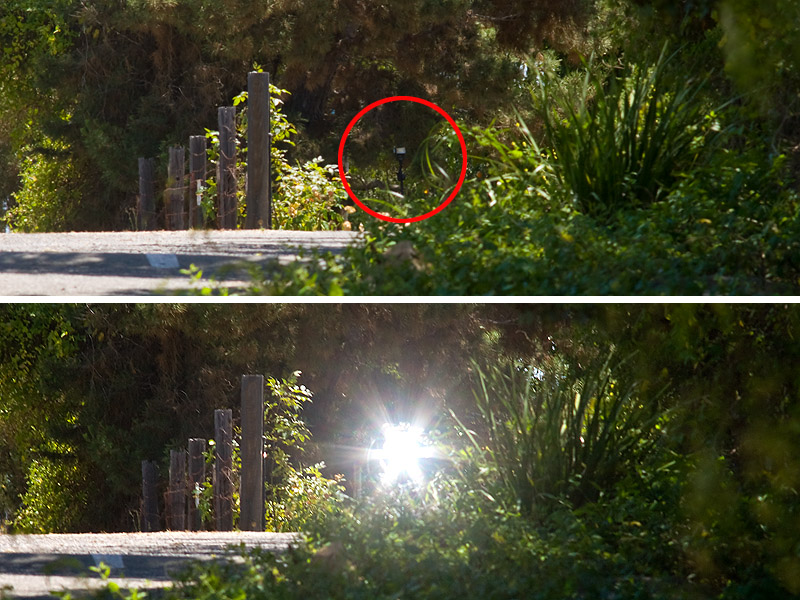
The claimed range of the RF-603 is 100 yards -- I paced off a 100-yard distance, set up a flash there, and reliably got the flash to trigger every time, without a single mis-fire (see image above). More good news: they're quick to trigger, meaning you can use your camera's full flash sync speed reliably. My older "Cactus" triggers are only reliable at about 1/3 stop below the full sync speed -- on my XTi camera, with a sync speed of 1/200th sec., about 1 in 5 shots at that speed would show a dark band, indicating incorrect sync. I had to use 1/160th sec. to get reliable syncing (and 1/200th on my 5D Mk II with a 1/250th sync speed). The RF-603s have yet to have a problem at the top sync speed of either of my cameras.
The bad news: these "smart" transceivers are a little too smart for their own good. The unit relies on the Canon E-TTL "wake up" signal from the hot shoe on the camera to figure out it should be a transmitter, which means that if you want to trigger your flashes by simply hand-holding one transceiver (with the other one attached to a flash), you're out of luck. No amount of pushing the built-in "test" button will convince the unit in your hand that it's supposed to be the transmitter, and it just sits there doing nothing. It also won't turn itself into a trigger if it's in a non-Canon hot shoe -- such as the shoe in my older "Cactus" remotes. And with no PC-cord *input* to trigger from, it won't work as a trigger from sound or optical triggers for high-speed flash, either. This is a camera hot-shoe only setup, reducing flexibility considerably.
As I mentioned, the units also include a camera-specific shutter release cable, for remote firing of the camera. You put a transceiver in the camera's hot shoe, attach the cable from the transceiver to the camera's remote release input, and then hold another transceiver in your hand. When you half-press the "test" button, the unit in the camera figures out it's supposed to be a camera trigger, the two units sync up, and a full press releases the camera shutter. This also works reliably in my tests, and up to 100 yards away. But *one* of the transceivers MUST be in a Canon camera hot shoe for the "smart" units to figure out their configuration -- no amount of twiddling or trying to fake them out (using a Canon off-camera cord, for example) would get them working in any mode without one of the units being in a camera hot shoe.
Overall, I'm a bit disappointed with the RF-603. They have some real, useful improvements over previous Yongnuo models (and other inexpensive Chinese models), but the limitations (no locking foot, no tripod socket, no triggering unless one of them is in a camera hot shoe, poorly-placed on/off switch) are problematic. They're just not nearly as flexible in operation as some other units (including Yongnuo's own previous models), and securely mounting them is difficult if not impossible. That said, I will be using these in my studio at home, where a simple one-in-the-camera, one-on-a-flash setup works fine, with the rest of my strobes going off with optical slaves (and they *do* reliably trigger my AlienBees and Adorama flashes). But I'll still be looking for another solution for outdoor speedlight work, and for my high-speed flash work. If all you need is a simple setup, these are a great bargain at about $32 a pair. If you need more flexibility or secure mounting, you'll have to look elsewhere for the time being, or wait and see what Yongnuo does next (which from past experience, should be in just a few months!).
Read more...

